|
-
25th June 14, 11:06 AM
#1
Their called the sound holes, if you cover one or both holes it changes the tone when playing the chanter. I seen the picture where is the mouth piece that goes on top? Be careful, what you see is what you get in the picture the chanter without the mouth piece.
hag
-
-
25th June 14, 03:34 PM
#2
I saw that. I was just goint to use the top of my current chanter but in retrospect I was very glad that I was outbid. I jumped the gun and almost wasted money! My chanter top might not have fit.
So...if I see those holes again I shouldn't freak about it.
Is this feature a mark of a good chanter?
I've noticed that the counter-sunk holes tend to be seen on nicer chanters.
Maybe one or some of our experienced pipers can start a sticky thread titled "Your Practise Chanter and You"?

The Official [BREN]
-
-
25th June 14, 09:37 PM
#3
No you don't need to freak out and in fact, the majority of practice chanters don't even have them.
As for counter sunk holes, some do and some don't....it's just a personal preference thing.
To some they make it feel more like you are playing a pipe chanter, as the holes on a pipe chanter are significantly bigger than those on a practice chanter......but I've not found the to be of any real benefit. To me they just feel like......counter sunk holes!!
It's not necessarily a matter of quality.
I have a 1921 hallmarked, silver mounted practice chanter which has been in the family for at least 60 if not 70 years and it originally had counter sunk holes. The bottom part has since been disposed off and replaced with a regular bottom part. Purely a matter of my own personal preference.
One other thing that I'll mention is that I used to have a delrin/poly practice for my son and the thing I did not like about it was that the edge/rim of the holes were fairly sharp.
Certainly not finger cutting sharp (!!) but sharper than any wooden chanter I've played. Maybe it was a one off, I don't know. A bit of mild sanding took care of the issue.
-
-
25th June 14, 11:08 PM
#4
Good to know. Excellent information here, gents.
My current chanter does not have either if the features being discussed (clearly).
On to another question:
If my intention is to eventually learn the smallpipes, too, am I correct in assuming that the fingering is pretty much the same? I am aware that some pipes, like the Uillean pipes, use different fingerings (I looked at a uillean pipes fingering chart and compared it to the GHB fingering chart...world of difference and another octave).
Lastly, I see that GHB have a couple of notes that can be fingered a couple of ways depending on whether it's a traditional piobaireachd or not. Wow!
Last edited by TheOfficialBren; 25th June 14 at 11:09 PM.
The Official [BREN]
-
-
25th June 14, 11:52 PM
#5
http://www.tartanthistle.com/Practic...ndard_Kit.html
Ditch that PC and get a real one. My PC came from Tartan Thistle and this link takes you to the whole she-bang. It's $117 for everything you see. I love the standard length Gibson PC and I much prefer the recessed holes. It just feels more like the pipe chanter and the Gibson also has finger spacing that's closer to the pipe chanter than some PC's.
You won't need pipes for at least 6 months of lessons, minimum. I got on the practice goose after 6 months and loaner pipes a couple months after that.
Make time in your day for a half hour of practice and stick with it. The pipes are fun.
As for different notes you mentioned, you probably mean the throw on D, there are two styles, the light and the heavy. I was taught the heavy throw. Just get good instruction and practice!
Last edited by 416 Rigby; 25th June 14 at 11:55 PM.
-
The Following User Says 'Aye' to 416 Rigby For This Useful Post:
-
26th June 14, 01:24 AM
#6
If it's Scottish smallpipes you are thinking about, then yes, the fingering is identical to a GHB, and in fact the chanter on modern SSP is almost identical to a practise chanter in design, so the hole spacing and size is almost identical too. Although you can play GHB tunes on SSP in the GHB style, traditionally smallpipes had their own repertiore and the tunes were played with fewer embellishments. Here's a couple of links that may interest you-
http://www.bagpipesociety.org.uk/the...ook-the-world/
http://lbps.net/lbps/index.php
As for buying a set (when the time comes) it's worth keeping an eye on the LBPS website as they have a 'for sale' section. As for what set to buy, Hamish Moore is generally considered to be the best maker, but he is no longer making production sets, only special orders. Ian Kinnear makes a nice set http://www.scottishsmallpipes.com/ but my vote for best value goes to E.J. Jones, who is in Texas. His pipes are beautifully made and the bores & internal dimensions are copied from Hamish Moore.
http://piperjones.com/instrument-making/
Here's my set-
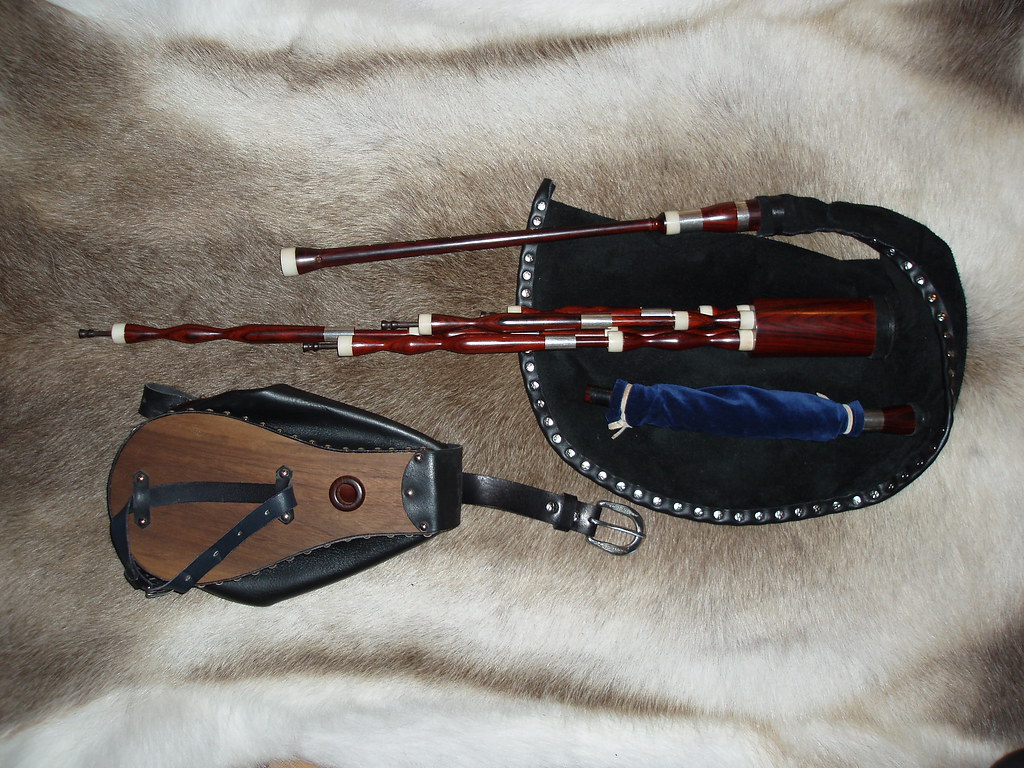 Smallpipes by Richard the Rogue, on Flickr Smallpipes by Richard the Rogue, on Flickr
PS the 'tone holes' or 'sound holes' are actually there to set the pitch of low G. Shorter chanters simply use the length of the end of the chanter to set low G. I've seen one very famous piper play the 'tone holes' with his knees to produce a low F as a trick!
Last edited by Calgacus; 26th June 14 at 01:28 AM.
Reason: Added info
-
The Following User Says 'Aye' to Calgacus For This Useful Post:
-
26th June 14, 10:20 AM
#7
As for different notes you mentioned, you probably mean the throw on D, there are two styles, the light and the heavy. I was taught the heavy throw. Just get good instruction and practice!
It's quite true that there are light and heavy versions of the D throw (I personally prefer the heavy), but TheOfficialBren is probably referring to the alternate fingerings used for the pibroch high A and high G, which have the effect of slightly flattening the notes.
The tone holes found on some practice chanters are found only on the long versions. They are necessary because the only real difference between a long PC and a regular one is the extra 3.5" or so of length below the low A hole. Without the tone holes, the low G on a long chanter would not sound properly. The tone holes are not required on a regular length chanter because the length of the chanter itself determines the pitch of the low G.
One simple trick for easing the sharpness of the edges of the holes on a polypenco chanter is to use very fine steel wool and rub until the holes feel comfortable. I don't play a poly PC, but I do this with my poly pipe chanters and they feel as comfortable as my blackwood ones. The very fine steel wool doesn't leave any scratches on the polypenco.
-
The Following User Says 'Aye' to imrichmond For This Useful Post:
-
26th June 14, 04:45 PM
#8
Is it definitely Scottish Small Pipes that you want to play?
Just a thought, but what about a set of 'miniature highland bagpipes' sometimes referred to as kitchen pipes, fireside pipes or chamber pipes?
I have a set that were made by Blue McMurchie a few years back.
The ones I had made wet blown, same fingering as GHB, chanter in Bb, have one bass, one tenor and one alto drone. Reeds are not hard to find.....although not necessary as I'm still using the original set!
 Great fun to play. Great fun to play.
Last edited by Ron Abbott; 26th June 14 at 04:49 PM.
-
The Following User Says 'Aye' to Ron Abbott For This Useful Post:
Tags for this Thread
 Posting Permissions
- You may not post new threads
- You may not post replies
- You may not post attachments
- You may not edit your posts
-
Forum Rules
|
|











Bookmarks