|
-
16th December 25, 08:55 PM
#8
 Originally Posted by carlb

That was exactly the kind of thing I was looking for. I had seen an earlier post from you with a catalog of clothing from the 1930s, which seemed just a tad too late. This is perfect!
My questions:
It's difficult for me to tell from the black-and-white photo, but it looks like the gentlemen in the photo are all wearing what we would now call a fly plaid. Do you think that's right?
Ah, that opens a can of worms, because "fly plaid" is loosely used to cover three quite different garments.
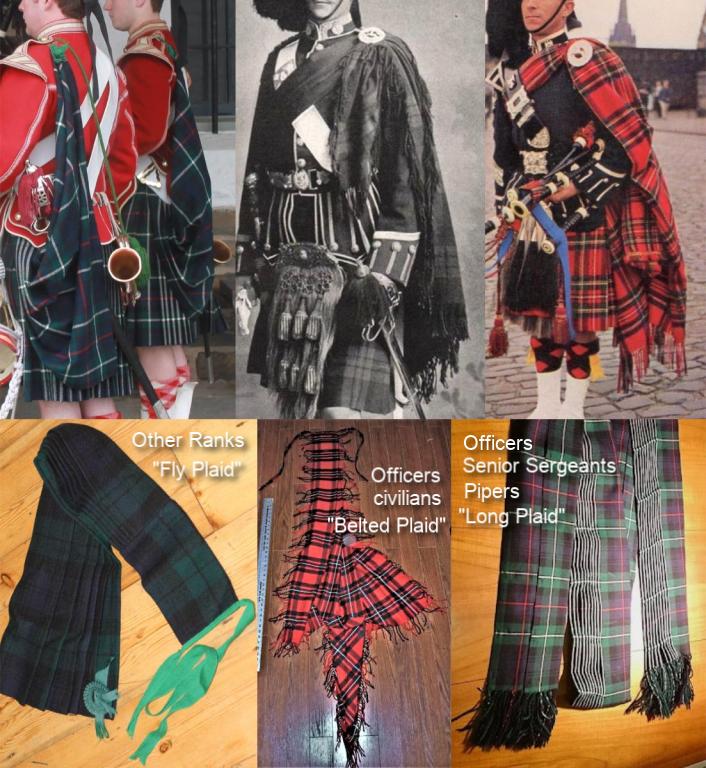
1) The thing called the belted plaid in all the old catalogues. This was introduced for army officers c1800 when the breacan-an-feileadh was abolished. By the late 19th/early 20th century it had become stantard in civilian Evening Dress as well. (As with some other items of Highland Dress it's unclear whether it had a military or civilian origin.)
The belted plaid is an elaborate tailored garment, essentially a big square of tartan, purled fringe on three sides, the fourth side pleated and 'let' into a matching tartan self-belt that goes round the waist under the vest, hence the name.
On the purled side opposite the side attached to the belt, in the centre, is a triangular piece of matching tartan, one side pleated and attached to the plaid, the other two sides having purled fringe. This fringed tab is passed through the left epaulette and a Plaid Brooch is pinned just below the epaulette.
2) The thing called the fly plaid in the military. This is a purely military garment, introduced for Other Ranks c1800 as a simpler, less expensive alternative to the Belted Plaid. It has a tape belt tied round the waist and ribbons at one of the top corners which are tied to the left epaulette. It is not fringed.
3) The thing called a fly plaid in modern civilian dress, introduced for Kilt Hire c1990 as an even less expensive alternative to the plaids above. It's simply a square of tartan which is pinned at the left shoulder with a Plaid Brooch and just hangs down in the back without any sort of belt.
I've often seen it disparagingly referred to as a nappie.
The nappie and the "Laird's Plaid" aside, here are the three traditional forms of plaid.
Originally Posted by carlb
I assume that the dirk would be worn using frogs, suspended from my usual kilt belt.
Right. Actually there's never been such a thing as a "kilt belt" because kilts aren't held up by belts like trousers are.
The dirk is suspended by the thing called a "dirk belt" in the old catalogues, worn to support the dirk, and not otherwise.
The thing of trying to hold up an ill-fitting kilt with a Dirk Belt under the Vest is purely modern.
(My use of "vest" is intentional as that would have been the word used in the period you're doing. My pre-WWI publications use vest, while my Interwar publications often use vest and waistcoat interchangeably, even in the same paragraph, though some stick with vest and some use waistcoat. I'm not sure when "vest" underwent a Semantic Shift in Britain.)
Around 1930, a new sort of Evening Dress jacket was invented, the Montrose Shell Jacket. (A "shell jacket" ends at the waist all around, and was an extremely popular military style in Victorian times.)
The Montrose was introduced with a dedicated waistbelt, narrower than the traditional Dirk Belt.
Ironically the Montrose appeared after the wearing of dirks, belts, etc had fallen from favour...so one could say that the Montrose was introduced with its own dirkless dirk belt.
Originally Posted by carlb
Since the gentlemen mentions that hose, "are now knitted and can be obtained in any pattern," could diced hose be considered appropriate?
Exactly so, diced and tartan hose have always been considered equally appropriate for Evening.
Originally Posted by carlb
Again, many thanks! I've got a lot more to work with than I did when I started thinking about this. 
You're welcome!!
It's awesome to see somebody take dressing to period seriously.
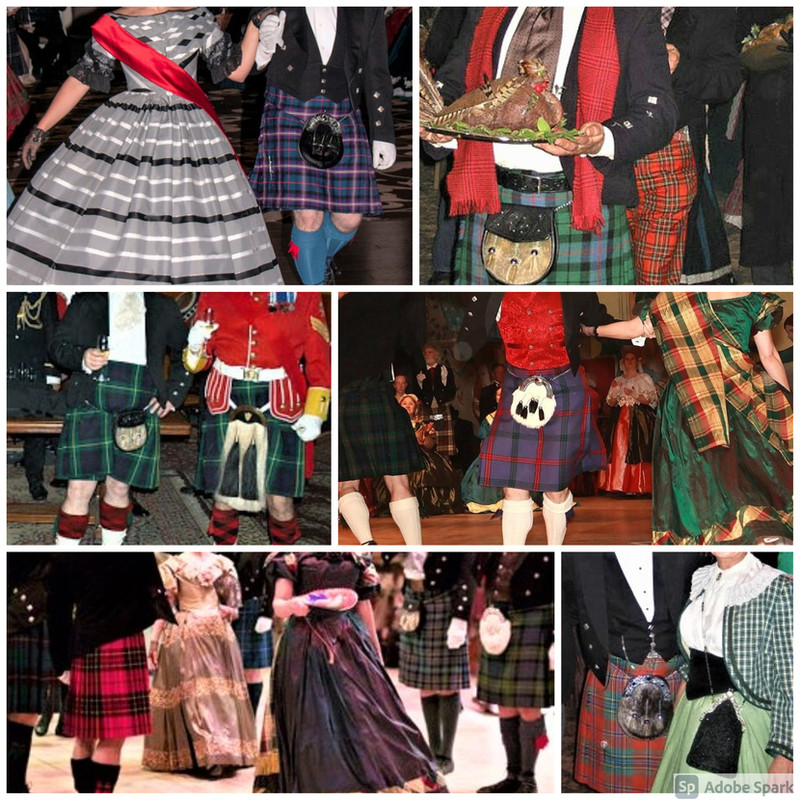
One of my soapbox issues is men showing up at Dickens Balls, Victorian Balls, Civil War Balls, etc wearing purely 20th century Highland outfits, as if Highland Dress floats outside of time itself.
Last edited by OC Richard; 16th December 25 at 09:13 PM.
Proud Mountaineer from the Highlands of West Virginia; son of the Revolution and Civil War; first Europeans on the Guyandotte
-
 Posting Permissions
- You may not post new threads
- You may not post replies
- You may not post attachments
- You may not edit your posts
-
Forum Rules
|
|









Bookmarks