|
-
clarification obtained!
 Originally Posted by Caradoc
Thanks Caradoc! I can relax now that I know! ;)
cheers
Hachiman
-
-
Originally Posted by Hachiman
Thanks Caradoc! I can relax now that I know!
No worries - it wasn't in the FAQ when I asked about it, and was added shortly thereafter.
That'd be why I knew it was in there. 
-
-
Alan...
Your posts most certainly havn't fallen on deaf ears. I was concerned enough, considering the cash I've laid out, to actually measure two of my "8 yard" kilts.
Kilt #1.
Henderson ancient colors, waist measurement 38", 16oz wool, 8.25" sett:
-actual length at the selvedge = 22'-9"
-23 pleats @ 9/16" reveal
-average pleat depth = approx. 4-1/2" (concealed depth)
-no double pleating
--------------------
This kilt is 7.58 yards
Kilt #2.
McApline modern, waist measurement 40", 13oz wool, 6" sett:
-actual length at the selvedge = 23'-2"
-34 pleats @ 5/8" reveal
-average pleat depth = 3" (concealed depth)
-no double pleating
-------------------
This kilt is 7.72 yards
Both of these kilt have substantial "heft" and nice swing.
I feel I've received everything I've paid for and more. I'm a happy camper.
I've read Barbs book so I quite appreciate where you're coming from with this. Still, I'm happy that the kiltmakers I've used have figured out how to magically cram the un-necessary mass of fabric into my (very close to) 8 yarders. 
blu
-
-
I addressed just this topic in an article in The Scottish Banner a year ago last February. Archived here:
http://kilts.albanach.org/yardage.html
And as an aside, that lovely honey-brown Harris tweed kilt and jacket photo from the museum, above, is not really a mid-nineteenth century kilt. It's a modern kilt, but made in the earlier box pleated style. Just so there's no confusion!
We do have a few vintage kilts in the museum from c. 1800 to 1850, though.
M
-
-
As one last "aside" to this conversation, the individual kiltmaker will have his/her own preferences for pleat depth. This can ultimately determine whether they pleat the kilt in a certain pattern. I, personally, like pleats to be no less than 3 to 3.5 inches in depth with a "show' of 3/4" to 1" (depending on how the math works out). In essence, that COULD mean that a 30" waist would only have 15 to 20 pleats. Ah... THAT'S how that works!
On the other hand, I made a kilt for a 37" waist that contained just over 9 yards of woolen tartan. Sure it had the weight of a cinder-block... but it was ordered that way.
As long as the pleat depth and numbers are good enough to hold the kilt in a nice, rigid drape and keep the pleats from wandering all over the high-acres... there's just no knowing the "required" amount of material.
Don't forget that the material can make a HUGE difference in how much to use too. Heavier fabrics and weaves don't need as much "weight control", so less material will still drape correctly.
*Weight Control* was a term that I was taught from the retired HoE instructors. It simply means that in order for pleats to maintain their position, they need to have a certain amount of mass for a straight hang. For those who work with 16 ounce wools 9or greater)... it's not really much of a factor.
Arise. Kill. Eat.
-
-
Originally Posted by Jimmy Carbomb
Don't forget that the material can make a HUGE difference in how much to use too. Heavier fabrics and weaves don't need as much "weight control", so less material will still drape correctly.
A light appliation of spray on starch to the inside face of lower weight materials when pressing/ironing can add 'gravitas' to rather flimsy stuff, as can sewing in a ribbon or tape at the hem, which also adds to the movement of the pleats.
-
-
Originally Posted by M. A. C. Newsome
I addressed just this topic in an article in The Scottish Banner a year ago last February. Archived here:
http://kilts.albanach.org/yardage.html
And as an aside, that lovely honey-brown Harris tweed kilt and jacket photo from the museum, above, is not really a mid-nineteenth century kilt. It's a modern kilt, but made in the earlier box pleated style. Just so there's no confusion!
We do have a few vintage kilts in the museum from c. 1800 to 1850, though.
M
Matt, does that jacket have an uneven hem or is it just a trick of the camera?
As a persnickerty sewer, I have spent several minutes glaring at the right side of it with an intensity likely to cause spontaneous combustion in the actual article.
The left side seems to be beautifully level, but the line looks to wander downwards on the right.
-
-
Originally Posted by Pleater
Matt, does that jacket have an uneven hem or is it just a trick of the camera?
As a persnickerty sewer, I have spent several minutes glaring at the right side of it with an intensity likely to cause spontaneous combustion in the actual article.
The left side seems to be beautifully level, but the line looks to wander downwards on the right.
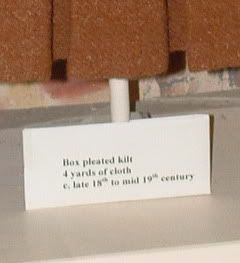
Matt, I misunderstood the card under that kilt
"A day spent in the fields and woods, or on the water should not count as a day off our allotted number upon this earth."
Jerry, Kilted Old Fart.
-
 Posting Permissions
- You may not post new threads
- You may not post replies
- You may not post attachments
- You may not edit your posts
-
Forum Rules
|
|













Bookmarks