|
-
8th October 06, 07:49 PM
#1
 Originally Posted by M. A. C. Newsome
... Gunn actually has more in common with Mackay, and this makes sense as the clans Gunn and Mackay were neighbors. ...
Taking this thought a step further, clan Mackay tartan has served as the basis for at least one other clan tartan, and if you were to just look at a map, it might not make much sense either. Remember, Mackay is a Scottish mainland (Sutherland) clan.
Look at the similarity between these two tartans.
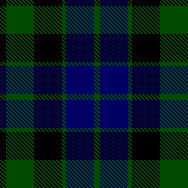 . . . . . . 
Mackay . . . . . . . . . . . . . . . . . . Morrison
The Morrison is nothing more than the Mackay tartan replicated faithfully, but with a red central tram line. Considering that clan Morrison is generally thought of as an Outer Hebridean clan, most people aren't aware of the close ties that existed between the two since the MacLeods chased the Morrisons off of Lewis a few hundred years ago (tribal war -- them #@%$! MacLeods!).
I've heard conjecture that this is because the same weavers made cloth for both clans and all sorts of other nonsense. In fact, the Morrison tartan was chosen very deliberately at the beginning of the twentieth century at a time when no one knew what tartan clan Morrison wore back before the Proscription Act of 1746. Because of their close ties, the Morrison tartan was based on the Mackay tartan, which was well known.
Later, while renovating a house on Lewis, a bible dated 1747 inscribed with the name Morrison was found bricked in behind a chimney. It was wrapped in this tartan:

Since then another sample of Morrison tartan was found dating from 1745. It is almost, but not exactly identical to the red-based example shown above (it had only one central green tram line, not two).
The point is that sometimes even when there are similarities between tartans, it takes some research to find out whether it's anything more than incidental, and if not, the real reasons.
One other lesson from all this is that back when people actually wore locally woven tartan cloth every day, they probably didn't always worry that the tartan was exactly just so. "EEK, your tartan is missing a tram line!" ... swoon ...
Regards,
Scott Gilmore
-
-
8th October 06, 10:30 PM
#2
Originally Posted by Scott Gilmore
Taking this thought a step further, clan Mackay tartan has served as the basis for at least one other clan tartan, and if you were to just look at a map, it might not make much sense either. Remember, Mackay is a Scottish mainland (Sutherland) clan.
Look at the similarity between these two tartans.
. . .
. . . . . . Mackay . . . . . . . . . . . . . . . . . . Morrison
The Morrison is nothing more than the Mackay tartan replicated faithfully, but with a red central tram line. Considering that clan Morrison is generally thought of as an Outer Hebridean clan, most people aren't aware of the close ties that existed between the two since the MacLeods chased the Morrisons off of Lewis a few hundred years ago (tribal war -- them #@%$! MacLeods!).
I've heard conjecture that this is because the same weavers made cloth for both clans and all sorts of other nonsense. In fact, the Morrison tartan was chosen very deliberately at the beginning of the twentieth century at a time when no one knew what tartan clan Morrison wore back before the Proscription Act of 1746. Because of their close ties, the Morrison tartan was based on the Mackay tartan, which was well known.
Later, while renovating a house on Lewis, a bible dated 1747 inscribed with the name Morrison was found bricked in behind a chimney. It was wrapped in this tartan:
Since then another sample of Morrison tartan was found dating from 1745. It is almost, but not exactly identical to the red-based example shown above (it had only one central green tram line, not two).
The point is that sometimes even when there are similarities between tartans, it takes some research to find out whether it's anything more than incidental, and if not, the real reasons.
One other lesson from all this is that back when people actually wore locally woven tartan cloth every day, they probably didn't always worry that the tartan was exactly just so. "EEK, your tartan is missing a tram line!" ... swoon ...
Regards,
Scott Gilmore
That Morrison red is still on my wish list, Scott. 
-
-
9th October 06, 01:03 PM
#3
***, that is a gorgeous tartan.
Kevin
Originally Posted by Tattoobradley
That Morrison red is still on my wish list, Scott.
Cheers
______________________
A 2006 study found that the average Canadian walks about 900 miles a year. The study also found that Canadians drink an average of 22 gallons of beer a year. That means, on average, Canadians get about 41 miles per gallon.
-
-
9th October 06, 09:17 PM
#4
Originally Posted by Oatmeal Savage
***, that is a gorgeous tartan.
Thank you Bradley and Kevin. When ordering, I chose the 1745 single tramline version. To my eye it had a better rhythm -- a better balance of spaces. I know that may not make sense, but here's a snapshot just the same.
Back on subject though, when you look closely at the two tartans side by side (I looked at swatches side by side when ordering the kilt), you can see the difference. Yet the two versions of the tartans were woven a mere two years apart. My take on it is that weavers simply wove something pretty much like the clan tartan, and variations were either unimportant (less so than now, anyway), OR deliberately woven to be subtly distinct versions of the same tartan.
The point is that I think we're a lot more wrapped up in the exactitudes of tartan counting now than they were when they wore the stuff every day to keep warm.
Regards,
Scott Gilmore
-
-
10th October 06, 11:24 AM
#5
Similarities between Gunn & MacKay tartans.
Gunn

MacKay

The thread counts on the two are slightly different. In appearance the red stripe is exchanged for a black (or vice versa).
MacKay Thread count: G6, B28, G4, K28, G28, K6
Gunn Thread Count: G2, B24, G2, K24, G24, R4
More on the relation between Gunn & MacKay:
Williamson's, Wilson's, Henderson's (three popular surnames with clan Gunn) are said to have lived in MacKay territory and paid rent there in. Clan MacKay also claims Williamson as a sept. Both clans feuded with each other most of the time. In 1585 the name Gunn was outlawed by the Earl of Caithness and all Gunn's were hunted by his forces. MacKay's were hired by the Earl, through chance, some of the Earl's forces unintentially caused the Gunn's and the MacKay's to from an alliance (of the top of my head, I believe it involved cattle). Anyway they defeated the Earl's forces at Altgowne (Allt-gamhna). This happens to be one of the stories of archery in the Highlands by the way.
In 1586 the Gunn's were defeated at Loch Broom by the Earl of Sutherland and remained loyal to the Sutherlands ever after. In 1745, The Sutherlands were the major government clan of the north, and the Gunn's and MacKay's followed. The key relations between these two clans are; territory, surname Williamson, feuds, then the alliance. Both clans also have the surname Neilson on their sept list.
the link to some of the above info:
http://www.electricscotland.com/webc...lt_Camhna.html
Caithness Clan Map

Here's that Barclay Tartan:

Like Matt said, it's missing the black bands that enclose the two blue bands.
Daniel S. Williamson
Last edited by sirdaniel1975; 10th October 06 at 11:28 AM.
-
-
10th October 06, 04:20 PM
#6
Originally Posted by sirdaniel1975
Similarities between Gunn & MacKay tartans. ...
Thanks for the information. Very interesting.
Regards,
Scott Gilmore
-
 Posting Permissions
- You may not post new threads
- You may not post replies
- You may not post attachments
- You may not edit your posts
-
Forum Rules
|
|











Bookmarks