|
-
25th June 10, 08:26 PM
#31
And then there is the quality of thread used to sew a kilt. A kilt sewn with poor thread is NOT going to last. Who ever asks their kiltmaker what type of thread they use and why?
A bargain price on a kilt is no bargain if the thread used to sew it up doesn't hold.
Soooo many variables and PRICE is probably the LEAST important of them all.
Ol' Macdonald himself, a proud son of Skye and Cape Breton Island
Lifetime Member STA. Two time winner of Utilikiltarian of the Month.
"I'll have a kilt please, a nice hand sewn tartan, 16 ounce Strome. Oh, and a sporran on the side, with a strap please."
-
-
25th June 10, 10:27 PM
#32
 Originally Posted by Ancienne Alliance

As for Lady Chrystel, her 8 yards knife pleated kilts are priced thus :
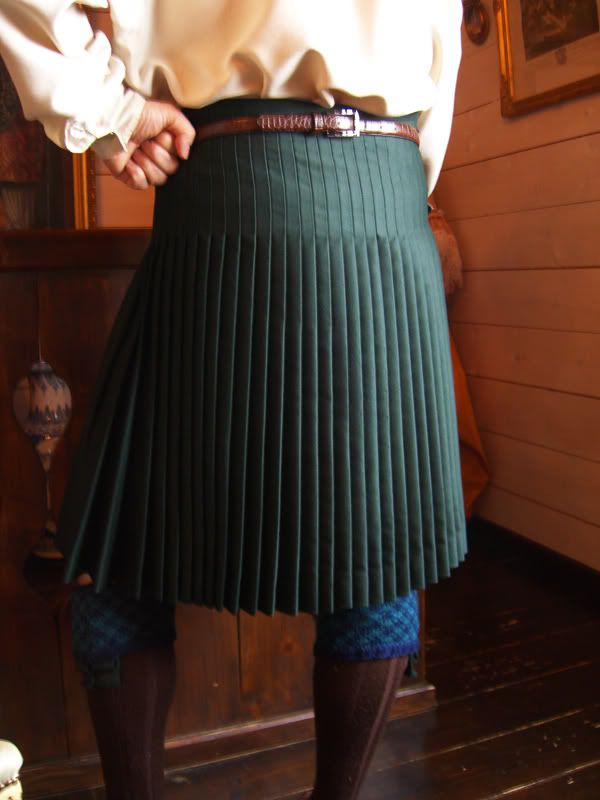
This pic pretty much sums up the word awesome. I am pretty much a staunch traditionalist and am usually not keen on solid color kilts, but I really like how this kilt looks especially with your choice of kilt hose, looks absolutely incredible.
"Blood is the price of victory"
- Karl von Clausewitz
-
-
25th June 10, 10:53 PM
#33
Last edited by Slag101; 26th June 10 at 07:22 AM.
-
-
25th June 10, 10:54 PM
#34
I like the price comparisons. Thank you for taking the time to do this analysis. I see some of our kilt makers have posted with some (as I interpret it) concern. In my opinion, this is how I view people who would buy a kilt.
I will group by numbers, there is not intended worth of the person that fits the type based on numbering, I am just calling it as I think of it.
Type 1.: Price is everything. They may not be able to afford/want to pay/or feel the need to pay top dollar, and will go for what is cheapest.
Type 2: Quality, within a budget. They will buy what they feel is the best they can afford.
Type 3: Name/Price. They will buy it for the name, or because it is very expensive because they can. Money is no object.
Type 4: Quality. They will buy what they feel is the best, price is no object.
Type 5: eclectic. They will buy from multiple sources, for multiple prices, either price being no object or what they can afford at the time. They like to have a collection of the different makers stuff, and a variety to choose from.
Type 6: The collector. They will buy different makers and styles to build on to a collection of clothing.
Type 7: Will buy kilts as they please from only one person, and swear by that kilt maker alone, and will buy no where else.
I am sure there are many subtypes, additional types, etc. No matter how you slice it, it seems that all our kilt makers must be doing well for themselves, because they continue to make kilts. It seems to me that this is a niche market, but it is large enough that enough talented people can market their wares, and can equally justify their prices. I think it is great to have so many options. When I say well, I mean that they are making enough of an income at it that they continue to be able to follow their passion. These truly are artisans, one and all, and I think it is great to see people carrying on with a trade that could have easily been lost. It is also neat to see some of the modern interpretations of this ancient garment, being transformed into a new thing of its own. Not to mention those who have revived the older, more traditional styles as well.
-
-
26th June 10, 12:00 AM
#35
Originally Posted by Slag101
In my opinion, this is how I view people who would buy a kilt.......
Type 1.: Price is everything. They may not be able to afford/want to pay/or feel the need to pay top dollar, and will go for what is cheapest.
Type 2: Quality, within a budget. They will buy what they feel is the best they can afford.
Type 3: Name/Price. They will buy it for the name, or because it is very expensive because they can. Money is no object.
Type 4: Quality. They will buy what they feel is the best, price is no object.
Type 5: eclectic. They will buy from multiple sources, for multiple prices, either price being no object or what they can afford at the time. They like to have a collection of the different makers stuff, and a variety to choose from.
Type 6: The collector. They will buy different makers and styles to build on to a collection of clothing.
Type 7: Will buy kilts as they please from only one person, and swear by that kilt maker alone, and will buy no where else.
Number 4 would describe me, however I'm on a very tight budget & not made of money, thus I have to save for a very long time to get the kilt I desire.
In the end, the quality of the kilt, the craftsmanship involved etc, is all worth it to me.
[SIZE="2"][FONT="Georgia"][COLOR="DarkGreen"][B][I]T. E. ("TERRY") HOLMES[/I][/B][/COLOR][/FONT][/SIZE]
[SIZE="1"][FONT="Georgia"][COLOR="DarkGreen"][B][I]proud descendant of the McReynolds/MacRanalds of Ulster & Keppoch, Somerled & Robert the Bruce.[/SIZE]
[SIZE="1"]"Ah, here comes the Bold Highlander. No @rse in his breeks but too proud to tug his forelock..." Rob Roy (1995)[/I][/B][/COLOR][/FONT][/SIZE]
-
-
26th June 10, 01:44 AM
#36
Interesting list but are you really sure they are all hand sewn? I'm pretty sure Heritage of Scotland doesn't actually offer full hand sewing because I asked not that long ago and was told even their proper kilts are made in a factory. Not sure about a couple of the other cheaper outlets too. How did you fact check? But good work anyway friend.
-
-
26th June 10, 06:02 AM
#37
Thanks for putting together this price comparison list, which I think will be helpful to many people doing research for their next kilt purchase.
I, for one, am happy to see the Scottish Tartans Museum listed where we are -- right about in the middle.
This reflects our approach to the kilts we chose to supply through our gift shop. We definitely wanted them to be high quality. But at the same time, we didn't see any need to go for the most expensive kilts available, either. The end result is a good quality, made-in-Scotland kilt that is available at a reasonable price.
-
-
26th June 10, 07:48 AM
#38
In Agreement
I agree with all of Riverkilt's advice on what most is important in purchasing a kilt. He and I also have the same kiltmakers, so I guess that that says a lot also.
However, I also agree with Slag101, that people tend to fall into different groups, sometimes at different times in their life. If I had known about the huge variation in kilt prices I might have purchased one 20 years ago. But then again, maybe there was not such a variety of materials and styles available 20 years ago.
I think that Bricekolob has provided a valuable service to the current and potential kiltwearing community. Is the initial chart perfect? No. Is it valuable as a resource to all of us? Yes. Is it a good starting point for discussion and decision making? Absolutely.
Thank You
Si Deus, quis contra? Spence and Brown on my mother's side, Johnston from my father, proud member of Clan MacDuff!
-
-
26th June 10, 08:15 AM
#39
This is a good list, Brice, although I should point out that my business name is Keltoi, not Keloti! 
I should also point out that my prices are in Canadian dollars, so (at present) they would approximately be $492-$700 USD ($510-$725 CAD)
[B][COLOR="DarkGreen"]John Hart[/COLOR]
Owner/Kiltmaker - Keltoi
-
-
26th June 10, 08:19 AM
#40
Originally Posted by Danwell
The way I understand this thread, it is to compare the retail $ only.
Special offers, discounts, and deals done for friends and colleague shouldn't count on this list because they are not options available for everybody. The only way to be fair is to list the actual retail prices that they charge.
You are incorrect, I'm afraid. The option is available to everyone. All one has to do is join X Marks the Scot to receive the 10% discount. (Which I'm sure most of have done! )
This would then bring the price for a Knife-Pleated Deluxe down to $459.00-652.50 CAD (approximately $443.00-$630.00). Quite a bit of difference, I'm sure you would agree!
[B][COLOR="DarkGreen"]John Hart[/COLOR]
Owner/Kiltmaker - Keltoi
-
Similar Threads
-
By The F-H.C.A.G. in forum DIY Showroom
Replies: 28
Last Post: 14th April 09, 08:02 AM
-
By Spartan in forum Show us your pics
Replies: 31
Last Post: 20th February 09, 07:51 AM
-
By Riverkilt in forum Traditional Kilt Wear
Replies: 16
Last Post: 25th March 07, 02:29 PM
-
By Manu in forum General Kilt Talk
Replies: 10
Last Post: 15th March 06, 04:04 PM
 Posting Permissions
- You may not post new threads
- You may not post replies
- You may not post attachments
- You may not edit your posts
-
Forum Rules
|
|








Bookmarks