|
-
6th March 13, 08:51 AM
#1
It's a fair point. One of the benefits of having a kilt made in the civilian world is that it can be made to measure rather than getting a kilt issued that has been worn by several generations of soldiers and is a close approximation. While we're on the subject, I hear two different views on how high a kilt should go. One is that it should go to the naval and the other is that it should be two inches above the naval and align with one's bottom rib.
I have two kilts, one that goes to the naval which I prefer to wear with a tucked in shirt and one which goes to the two inches above line which I prefer to wear with my coatee as it guarantees no shirt peeking out below my waistcoat.
Is there a general consensus on which of these two measurements is preferable or is this another area of conjecture?
(I hope the thread isn't wandering too far off course...)
Some of my fellow Nova Scotia Highlanders...

Cheers!
Last edited by Nathan; 6th March 13 at 08:54 AM.
Reason: added pics...
Natan Easbaig Mac Dhòmhnaill, FSA Scot
Past High Commissioner, Clan Donald Canada
“Yet still the blood is strong, the heart is Highland, And we, in dreams, behold the Hebrides.” - The Canadian Boat Song.
-
-
6th March 13, 10:36 AM
#2
-
-
6th March 13, 12:06 PM
#3
 Originally Posted by Nathan

While we're on the subject, I hear two different views on how high a kilt should go. One is that it should go to the naval and the other is that it should be two inches above the naval and align with one's bottom rib.
There's room for individual preference on this, of course. When it gets much below the navel it starts looking like a Utilikilt or another of that ilk. I don't think a military rise looks bad at all, but it's not my preference. Personally, I like mine at about an inch to an inch and a half above the navel, which I find very comfortable and also high enough to not cause issues with a waistcoat.
Here's an example from this past Friday evening at an art gallery in San Francisco, where I was one of four judges in a contest:
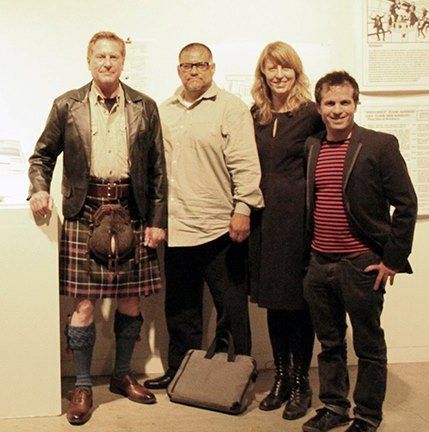
And yes, I like my own kilts right at the top of the knee.
Last edited by Dale Seago; 6th March 13 at 12:27 PM.
"It's all the same to me, war or peace,
I'm killed in the war or hung during peace."
-
-
6th March 13, 02:57 PM
#4
Yeah, the top of the kilt seems to vary a lot, depending on body shape. Not everyone's navel is in the same place, so that's a poor guide to use. The best location for the top of the kilt is for the straps to be centered right at the 'dip' that defines your natural waist, and the actual top binding ends up... wherever that happens to be (which will depend on the rise of the kilt). In my opinion, this is truly what defines whether a kilt is going to fit you well. It's all about the straps and your natural waist, and has nothing to do with the actual top edge of the kilt.
It can, of course, be hiked up or down as needed if the bottom selvedge is way off from its ideal location, but if you do that, it just won't be fitting you ideally at the waist.
I'm naturally high-waisted, but it just doesn't feel right if I wear my kilt lower than that, and it makes it harder for it to stay in place.

-
-
6th March 13, 06:20 PM
#5
Tobus has it right -- the kiltmaker determines where the top of the kilt should be by placement of the waistline/top strap. Whatever material extends above that (the rise) is a matter of preference/style, but is built into the kilt. If you try to hike a low-rise kilt up too high, it will self-correct by settling down until the top strap rides at your natural waist. . . assuming you haven't done something odd like buckle the lower strap (if it exists) tighter than the top strap.
Proudly Duncan [maternal], MacDonald and MacDaniel [paternal].
-
-
12th March 13, 05:46 AM
#6
-
-
12th March 13, 06:23 AM
#7
Very interesting catalogues, Richard. So what vintage is that DP/H sporran photo? From the 1960s?
I have been told by some that "semi-dress" sporrans are the appropriate choice and were designed specifically to wear with the semi-formal black barrathea argyll jacket which also occupies the middle ground between the prince charlie coatee and a tweed day jacket. What are your thoughts on that?
If I was wearing that type of jacket to this type of event, would the full dress fur sporran with silver cantle be a little too much or just right?
I find everyone's views on sporran choice interesting and informative so while I'm on the subject: Given the waning popularity of the fur industry, if I was going to be among a particularly activist crowd, what do you think the most appropriate non-fur alternative would be for full dress?
Finally, how do you feel about a black day sporran as opposed to brown for day dress and what type of buckle would you recommend to dress down my belt a little? I've been told something with a brushed finish would be fine, but I'm hesitant about any kind of "plate" style buckle on a black belt.
N
Natan Easbaig Mac Dhòmhnaill, FSA Scot
Past High Commissioner, Clan Donald Canada
“Yet still the blood is strong, the heart is Highland, And we, in dreams, behold the Hebrides.” - The Canadian Boat Song.
-
-
12th March 13, 07:14 AM
#8
Originally Posted by Nathan
I have been told by some that "semi-dress" sporrans are the appropriate choice and were designed specifically to wear with the semi-formal black barrathea argyll jacket which also occupies the middle ground between the prince charlie coatee and a tweed day jacket. What are your thoughts on that?
That's my understanding of why they were invented too. Seems like a reasonable compromise between day sporrans and evening sporrans, allowing one to dress somewhere in between. But I rather tend to think that this is more a function of our modern tendency to dress more casually than in generations past.
If I was wearing that type of jacket to this type of event, would the full dress fur sporran with silver cantle be a little too much or just right?
Personally, I think if you were wearing a black Argyll with silver buttons to an evening event, any dress sporran with a silver cantle would be just fine with it.
I find everyone's views on sporran choice interesting and informative so while I'm on the subject: Given the waning popularity of the fur industry, if I was going to be among a particularly activist crowd, what do you think the most appropriate non-fur alternative would be for full dress?
Not sure how to answer that one without knowing the nature of their "activism". Would they be opposed to a sporran with horse hair or goat hair too? I can't think of any traditional sporran choices that don't involve animal products.
Finally, how do you feel about a black day sporran as opposed to brown for day dress and what type of buckle would you recommend to dress down my belt a little? I've been told something with a brushed finish would be fine, but I'm hesitant about any kind of "plate" style buckle on a black belt.
N
Black day sporrans are very traditional, and actually it seems that most Scots prefer black over brown. As I recall when I searched through photos from Highland Games in Scotland, it seemed about 25% of the gentlemen were wearing brown sporrans and shoes, while 75% were wearing black.
As for dressing down a kilt buckle, first you might want to consider not wearing a belt at all. It's not actually required, and a lot of folks don't wear one. But if you do feel that you want to wear a kilt belt and want to avoid a shiny waistplate, there are options for less flashy buckles that still fit a traditional kilt belt (without going to a bar-and-tongue style buckle). This is what I normally wear if I'm going to wear a kilt belt with daywear.

-
Tags for this Thread
 Posting Permissions
- You may not post new threads
- You may not post replies
- You may not post attachments
- You may not edit your posts
-
Forum Rules
|
|










Bookmarks